ral's notebook …access to all of ral's online activities

Nonamesville

December 27

In a previous post, I illustrated how the word spark ”moiling” led to word work that in turn led to a dream with words that rhymed with moiling but were not “real” words. I then showed how I sometimes work with a dream in using the dream itself as a “spark” to enter into fictive space and see what would be presented there. That led to a Lewis Carroll-like piece entitled, “Goiling.” When Paco responded with a continuation called, “Mr. Differently Has A Class to Teach,” I was not surprised because we have been engaged in a number of projects using alternative authorial narrative.

In the spirit of this alternating, I responded with a piece entitled, “Differently Phones Lockhart,” and Paco, in turn, sends me “Lockhart Phones Bertie.” Now this will likely be the last post on this back and forth. Whether it becomes another serious project (in spite of its whimsical character), I do not know. We never really “decided” in the usual sense to carry on these narratives, but simply responded back and forth until they grew into quite sizeable stories.

I hope these pieces will give you a sense of both the serious nature of what we are up to as well as the fun we are having. When being scribe to what presents itself in fictive space, it is not so much “our” narratives that emerge, but the narratives of something “other” responding to the warmth of our attention. This perhaps gives one an understanding of why the fictive content can weave into itself various realities.

Your comments are always welcome, wither on the blog itself or via email.


Differently Phones Lockhart (RL)

“Lockhart here. Who’s calling?”

The old Scot sat himself in his black office chair, leaned back and set his feet atop the old cedarwood desk.

“Ah, Differently, good to hear ye me good man. But how is it your a callin? I don’t recall putting phone lines in Nonamesville.What’s that you say? Things arrive of there own accord? But Differntly, wha’ about authorial control and all that jazz?

Lockhart, took his feet off the desk and leaned forward in his chair, rubbin’ at his beard, something he did when he was thinkin’ hard.

“Chalk? You need chalk? Yes, I know teachers use chalk when they teach. You think I’m a dimwit? What happened to the chalk? Pretty sure there was plenty. Blackboyd? Who the bloody moon stone is Blackboyd? No, that wasn’t me. That’s not an idea I would have, or even want to have, even after nippin’ some old Macallans.”

Lockhart stood up, reached across his desk and picked up a scratch pad. There was still some room after all the morning’s doodling.

“Differently, I think I know what’s happened. Hang up and answer the phone when it rings. By the by, what’s your number there? What do you mean you don’t care much for numbers? They won’t behave? Ok, forget the phone. There’s other ways to deal with this.”

Lockhart dialed a number.


Lockhart Phones Bertie (PM)

Buzzz. Buzzzz. Buzzzzzz.

“Come on, dammit, answer the phone, will ye?” Lockhart was about to extend this line of invective when suddenly the connection was made and a hoarse female voice, approximating an old gray mare with bronchitis, spoke on the other end:

“Who the hell is it, botherin’ me at this ungodly hour?”

Lockhart, stunned, had no ready quip with which to reply. The phone line lay flaccid, bereft of vibratory energy, filled with nothing but “dead air.”

“Well, fuck off then, if yer gonna be like that about it,” shouted Bertie—or rasped, rather—into the receiver, and was about to slam the device down in its old fashioned cradle when Lockhart recognized the raspy old voice.

“Bertie? Is that you?”

“What do you mean is it me? ‘Course it’s me. Who else can I be? Wait a minute. Is that you, Lockhart?”

“Yes, Bertie, it’s me, Lockhart, your old author, if, that is, you remember.”

“Remember? How the hell could I forget? You burned down my store, you bugger!”

“I’m sorry, Bertie, but I didn’t really do that. It had to be the nefarious agents of certain big shots in Rome. The Vatican, to be precise.”

“Well, you can be as precise as you want, Lockhart, but I still say it’s a crock a shit yer deliverin’ to this old lady. And after I brung ya the proofs, all the way to Seattle.”

“Yes, I admit, Bertie, you’re right about that. And I apologize about the fire. But, you know, authorial authority and all.”

“Yeah, I’ve heard it all, Lockhart. But now that you’ve got me all riled up, why the hell did you call in the first place?”

“I’m trying to reach Differently. Do you know his number?”

“Number? He don’t do numbers. Says they ‘don’t behave.’”

“Yes, he told me.”

“You mean you talked to him?”

“Yes.”

“Well, just call him back then.”

“I’m afraid that’s easier said than done.”

“But what about all your ‘authorial authority’ bull shit? Can’t you just dial 911 and tell ‘em you need to talk to Mr. Differently ASAP?”

“Uh, Bertie . . . “

“Oh, I see. It don’t work that way where Differently lives, right? He lives in La-La Land.”

“Something like that. But, yes, you’re correct, Bertie.”

“Well, you’re a hell of an author, you are, Mister Lockhart. But maybe I can help you out anyway—though I don’t know why I should.”

“You mean you have an idea, Bertie?”

“Of course I got an idea. I got lots of ideas, all the time. Here it is: Just call Anyone.”

“Anyone?”

“Sure. What the hell’s the difference, anyway? You’re bound to get Differently sooner or later.”

“That’s actually a good idea, Bertie. I’ll just start dialing Anyone, and sooner or later I’ll reach Differently. But there’s one more thing.”

“Yeah? Now what?”

“Differently needs some chalk.”

“Oh boy. What did I get messed up in? Just tell him to go down to the dime store and buy a box of chalk.”

“Uh, Bertie, they don’t have dime stores any more, especially where Differently is concerned.”

“Jesus, Joseph and Mary, Lockhart. Are you sure you’re writin’ this crap, or is it writin’ you?”

Bertie was losing patience and began tapping on the cradle with her fingernail.

There was a long silence, apart from the tapping.

“Lockhart? Still there?”

“You want the truth, Bertie?”

“Course I want the truth!”

“I don’t know if I’m here—or there.”

“Well, then it don’t make any difference, does it?”

And with that Bertie hung up on Lockhart, who quickly poured himself another shot of Macallan and took his cat’s cradle string out of his desk drawer, weaving it through his fingers, in hopes of calming his nerves before dialing Anyone.

[Bertie is a main character is Russ’ novel–not in alternating form–entitled, Dreams: The Final Heresy.]

Mr. Differently Has A Class to Teach

December 22

In a previous post I described how Paco and I have been engaged in what I clumsily call “alternating authorial narrative.” Examples of such narratives will be published in the future (Fex & Coo, Deathling Crown Lottery and The Museum of Indifference are in the works). A fresh example of this is Paco’s response to my blog post entitled “Groiling.” His piece is entitled, “Mr. Differently Has A Class to Teach.”


Mr. Differently Has A Class to Teach


Mr. Differently was thrashing back and forth through the piles of thrash, searching for . . . searching for . . .


“Damme now, what was it?” said Differently, annoyed. “I’ve got a class to teach!”


“Boyp!” The sound came once from the thrash pile, then again: “Boyp! Boyp!”


Differently stopped his thrashing and listened for . . . listened for . . . oh yes, the Thrash Pile Voice. Finally, it came:


“That you, Boss, thrashin’ again? Soychin’ for?” came a reptilian-amphibian voice in reply, followed by another boyp.


“Yes, I’m Differently. I do things my way. Who are you?”


“Aw, Boss, you knows who I am. I’m always sittin’ in your thrash pile, boypin’ an’ choypin’ and eatin’ doyty woyms. I’m Mr. Blackboyd, like the one you’s always chalkin’ on when you’s teachin’.”


“Excuse me?”


“Alright, yer ‘scuzed,” said Mr. Blackboyd, who, charmed by his own humor, finished with a prolonged, stuttering snort, “A-hunh, a-hunh, a-hunh!”


“If you please!” said Mr. Differently, almost shouting now.


“I ‘spose you wanna go Goilin’ today, with all them others,” said the Thrash Pile Voice.


“No, I teach Koiling. That’s my specialty. Koiling—get it? ing, ing, ing, not in’ in’ in’. And where’s my chalk? Have you been eating my chalk again?”


“Chawk? You mean that white stuff?”


“Yes, the chawk—I mean, the chalk.”


“Oh, yeah, maybe I did. Keeps me from boypin’ so much. You know what it’s like, eatin’ all them doyty woyms all day. Didja need it or somethin’?”


“I just told you, I have a class to teach!


“What time’s yer klass?” said Mr. Blackboyd, unpertoybed, eyeing a doyty woym just emerging from the muck under the Thrash Pile.


“It starts when I get there!” said Differently, enunciating slowly and clearly, while clearly and slowly losing his temper. “So if you would be so kind as to evacuate my thrash pile, I’ll get on with my search.”


“Sorry, Boss. Won’t do no good. I ate the chawk. You can thrash all day and you won’t find it. Too late.”


“Well, don’t you have some hidden away? Some little stash in a grubby little hole somewhere? How else will I teach my class?” This was going differently from how Mr. Differently had planned his big Goiling Day Koiling Teaching Day.


“Got me, Boss. How many students ya got?”


“Well, how should I know? It depends on how many show up, don’t it—I mean, doesn’t it? Yes, Class Count goes differently on different Teaching Days,” said Mr. Differently. “After all, it can’t always be the same, not here anyway.”


“Can’t help ya, Boss. All I know is, I ate all the chawk, so it’s gone. Poof. Poop. Oops. Just like that.”


“This is an outrage!” Mr. Differently trembled as he spoke. “Well”—he paused, his breathing nearly convulsed—”it’s the very last thing I want to do,”—tremble, tremble—”but I suppose I have no choice. I’m going to have to call in Lockhart. He’ll have some cockamamie idea about what to do. After all, we’re both teachers.”


“Sounds like a plan, Boss, an’ the only plan ya got.”


“Mmmm,” replied Mr. Differently, though bitterly begrudging his assent.


“Boyp!” replied Mr. Blackboyd, as a way of signing out, and with that he burrowed back into the thrash pile, where, we suppose, he intended to take his daily nap, leaving Mr. Differently to get Lockhart on the line.

Alternating Authorial Narrative

December 20

Some years ago in the pages of Dream Network Journal, I described a “conversation” between two women painters. The conversation was not in words, but in paintings. A painting would be sent, and the recipient would respond with a painting and this alternation would continue for some time. Finally, the whole set was exhibited in a gallery. It was stunning.

Years later, Paco Mitchell and I began to do something of the same thing, only in words. He would send me an email on a certain topic we’d taken up and I’d return one—back and forth, alternating. This ultimately became a full-fledged dialogue, and was published this year as a book (Dreams, Bones & the Future: A Dialogue. For information on this book see http://dreamsbonesfuture.com).

During the course of our dialogue, something else began to occur. This began one day from an email I sent to Paco describing my experience at Tully’s Coffee Shop in downtown Seattle. I had been mulling over Goethe’s admonition to really look at what one sees and to find the story there. In doing so, I looked out the windows of Tully’s and saw FedEx and Costco delivery trucks. But in looking at what I saw actually it was “Fex” and “Coo.” The pillars and window casings blocked some of the letters. In looking further Sterling Bank became ling Bank, Key Bank became Key. A Sale became Sal and the UPS truck became UP. I did not make these up in anyway. They were just “there” if I looked instead of experiencing what I was seeing that is so readily filled in by the mind.

So I went into fictive space and waited for storymind to come forward with some “continuation.” This is what “formed itself” and “presented itself” to me: Sal is a teller at Ling Bank. He does not yet know that Fex and Coo have decided that ending it is the key. They have been held up by matters that do not concern us. You may not agree. That’s fine, it is not a requirement. You will see. I sent this to Paco to tell him about my experience.

What I got back was a continuation of the story of Fex & Coo. This began a long series of alternating fictive pieces which now has grown to several hundred pages. This approach to writing a novel is not altogether new, but the experience of doing it holds many surprises. First, one must let go of any ego investment in how the story is going to go. Second, each received new piece is an occasion for a cascade of unexpected and unintended narrative development. It is all so surprising! We now have two other novels in process written in this form of alternating authorial narrative: Deathling Crown Lottery and The Museum of Indifference. These two projects began in dreams I had that I sent to Paco and his response was his own storymind continuation: not interpretations, not analyzing, not explaining. This is an astonishing way to relate to dreams.

It was not surprising then when I posted “Goiling” that Paco sent along his continuation. That I will post next time.

FICTIVE SPACE & STORYMIND

December 18

FICTIVE SPACE & STORYMIND

In the last post, I illustrated how a word leaps outside one’s conscious intention and becomes a “spark” (or “flirt” to use Mindell’s language). These sparks are ephemeral and unless consciousness attends to them, they are short-lived and disappear. They may recur in dreams in one form or another often without any recognition. In this instance, I described attending to the word “moiling” and the word work I did. This was then followed by a dream which presented me with 9 “unreal” words. It is my habit now in working with my dreams to put the search for “meaning” on hold, keeping interpretation at bay, and doing what is necessary to what I call “entering fictive space.” I try to empty my mind of its busyness and literally face a blank page (a piece of paper or an empty writing space on the computer). If there is any “intention” in this, it is to be fully present in fictive space to what I call “storymind.” The mind functions to produce stories. We live in these stories without a great deal of awareness of the full extent to which this is true. The readiness to produce stories is one of the primary features of fictive space. So in this space, I “wait” for storymind to begin its weaving. This may occur first in an image, or perhaps a word, or a sound, even a smell—it can be anything. I am in no sense “trying” to do something, but concentrating on being receptive to what presents itself. In working with the dream of the nine “unreal” words, what came was seeing a sign with the word “Goiling” on it. Once the fictive space becomes animated in this way, I begin to function something like a scribe, writing out what comes. One of the hallmarks of being in fictive space and with storymind alive, is that the whole process is effortless. Here is what happened.


GOILING

Along a path amidst dense vegetation a sign points to Goiling straight ahead puzzling the young Miss; not the sign nor the pointing but the word there. Must be a town she concluded.

“Hello! Is anyone here?” Seeing no one, she began heading on to Goiling when the silence was broken.

“Anyone left quite a while ago Miss, in search of.”

She looked all about but could not locate the source of this odd utterance. The voice was not threatening so much as strange sounding, as if a muted fog horn was hidden amongst the foliage.

“In search of what?” she countered.

“No my dear, What is just over there. What would never go off in search of.”

She looked around her and could see no one and she said as much a bit louder than intended and with an edge of annoyance she didn’t mean either. But there it was.

“But surely you can see all of us. We are all here except Anyone. Perhaps you are not looking my dear. Looking is quite different than seeing as you must know.”

“I know no such thing!”

“Well, now, that’s a treat to be sure. It isn’t your everyday traveler who knows No Such Thing. It’s because he is constantly moving, not rooted at all. Strange for our kind, you know.”

“And what kind are you then?”

“You’ve eyes, Miss. Perhaps you should use them.”

“What’s your name then?

“No, What’s not my name. My name, should you ever have need of it, is Zoil, after the color of my leaves.”

“Ok, then. Mr. Zoil, thank you for that. But what color is zoil exactly?”

“Zoil is zoil of course. You’ve eyes, as I said, but they don’t seem to be much use to you. Perhaps after the match you will be able to see more clearly. Of course that requires true looking.”

“Match?” She didn’t want to say “what” again as it only seemed to cause trouble.

“Of course, my dear, today is Goiling Day. That’s why the sign is there.”

“You mean you go to Goiling on a particular day, like going to market on Sundays?”

“No, Miss. We all go a-Goiling, not to Goiling.”

“What is Goiling,” she said as exasperated as she felt.

“No, no, no. My dear. What never goes Goiling. What is firmly planted.”

“I do so wish you’d let me see you. All I see are plants, plants everywhere.”

“But my dear, you are seeing us.”

“But plants don’t talk!”

“Ah, after the match, you will know Differently.”

“Differently?”

“Yes, Differently is one of our master teachers; teaches koiling, he does. Come now, you must be off. It’s time it is to go a-Goiling.

WORDS AS EGGS: “Moiling”

December 13

Those of you who know my book Words As Eggs, know that I can’t leave words alone, or, more accurately, words won’t leave me alone. I’ll be reading along and, without warning, a word will leap at me, tethering me to it until I give in and take up what I call  “word work” with it.

     The most recent experience occurred while reading James Howard Kunstler’s  acerbic critique of artist Damian Hurst, in the course of which he used the phrase, “Zombies moiling outside the building.” Moiling leapt at me. I had not seen the word used in years, and even longer since I used it. I recalled its meaning as “toiling,” and this sent my mind into an associative spree, with “boiling, coiling, poiling, roiling, soiling.” Hey, at my age, the mind being spontaneously associative is a good sign, neurogenesis and all that. As I began my word work, I saw that the word derived most immediately from the Middle English moillen, meaning “to soften by wetting.” As you can see, it’s not immediately clear how we get from “soften by wetting” to “toil.” Such word puzzles I find very useful in keeping an active mind. In looking through the historical usage of the word (as is possible in the Oxford English Dictionary), one begins to see it and often a phrase will make the picture easier to see: to toil in muck and mire. To dig deeper into the pre-history of the word, we find its Indo-European root to be mel-1, which refers to “melt, soften, slime” The root is intertwined with mel-5, meaning “grind, mill.” Sloppy work, one might say, as befits the toil of Zombies.

     These words that grip me, often lead to dreams as well. Such was the case with moil. In the dream, I am writing on a blackboard and though I am not aware of any students, I am teaching. I am listing words related to moil: goiling, hoiling, joiling, koiling, loiling, voiling, woiling, xoiling, zoiling. As you can probably tell, none of these words I am listing are “real” words. I am about to ask the class to take one of these words and to develop a meaning for it. At this point I wake up.

     We live in a time where we are quite aware of words newly made up—most especially words related to the advancements in technology. Now here is a dream that introduces nine new words. (How does the dream know these words I’ve never experienced before?) So to linger with the dream itself, rather than ask what the dream means, I focus on what the words mean. In a subsequent post, I’ll let you know what I did with this “task.”

     But now, let me ask you to focus on this task as if you were a student in this class of mine.

Memories of Training–Gilles Quispel

December 10

I did my analytical training in the late 60s and early 70s. I was

fortunate to have met and been taught by many people who

had direct experience with Jung. From time to time I’ll post

a memory of those times.

     One such figure was the gnostic scholar, Gilles Quispel, an

extraordinary many by any measure. He was instrumental in

securing the Jung Codex for purchase by the Institute in Zurich

as a birthday present for Jung.

     The memory that stands out to me is one training seminar

in the early days. At one point, as we were discussing the nature

of “mystery,” he stopped us. He put his index figure to his lips

as if telling us to hush a bit. Then he said something I’ll never

forget:

Mystery is not to be solved, or resolved, or dissolved. Mystery

is to be embraced, loved, and out of that will comes one’s

deepest sense of life, meaning, and purpose.

I remember thinking then that dreams are a mystery and what Quispel

was saying was true of dreams as well.

COMING SOON – The Final Interlude: Advancing Age and Life’s End

December 5

The Final Interlude: Advancing Age & Life’s End by Lee Roloff and Russell Lockhart

will be available shortly. If you would like a complimentary pdf copy please email

Russ Lockhart at ral@ralockhart.com.


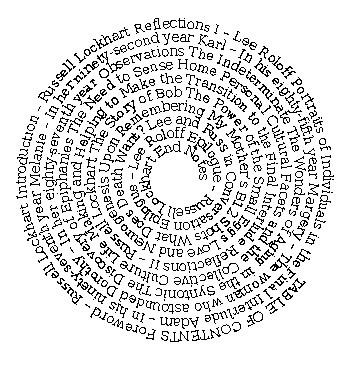
Here is a spiral image of the Table of Contents

InterludeTOC

Coming soon!

December 2

Hi all,

Many thanks for your joining ral’s noteboook blog. I have not been very attentive to posting but this will be changing soon. You should be getting an email when I post and if not, let me know at ral@ralockhart.com.

My best wishes,

Russ

Now Available!

April 20

The republication of Words as Eggs is now available for purchase.


WordsAsEggsAd

http://www.amazon.com/Words-As-Eggs-Psyche-Language/dp/0911783008/ref=sr_1_3?s=books&ie=UTF8&qid=1366466153&sr=1-3&keywords=russell+lockhart

COMING SOON . . .

October 14


Re-publication of Russell Lockhart’s WORDS AS EGGS.

As timely now as it was when first published thirty years ago!

Quietly passionate and urgently intent, this book belongs
to the very best tradition of depth psychology. It appeals
first of all to the intelligently psychological reader who wants
new modes of understanding. Lockhart offers countless
insights to analysts and counselors in daily practice. His
voice is original, undogmatic, sensible and wise.

–Spring Publications


Words as Eggs is a profound and moving exploration of
the messages of dreams found in the images and in
language chosen to describe the experience of dreams.
Words are the “eggs” of mystery and revelation as a
dreamer discovers the “history of meaning in the language”
the ego has yet to grasp, yet seems to know in dreams!
Lockhart is a guide for a greater consciousness as psyche
utters the dream experience. Yes, psyche “speaks” but
also “knows”! The dreamer can learn from dreams in ways
hat simply astound. Russell Lockhart’s brilliant book can
awaken this astonishment.

–Lee Roloff, Ph.D., Jungian Analyst


To receive notice when Words ss Eggs will be available
in paperback and in Kindle format, send email to me at
ral@ralockhart.com.
                                         Many thanks for your interest!


« Older EntriesNewer Entries »